
The Hidden Bottleneck in Small-Batch Physical Crafting
For small-batch craft businesses and hobbyist creators alike, the biggest bottleneck in production isn't cutting machine speed—it is the manual labor of weeding delicate heat transfer vinyl. A visually stunning digital design often turns into a production nightmare if the underlying vector paths contain micro-cavities, discontinuous strokes, or open paths that tear under blade pressure.
When producing physical apparel, wood door hangers, or vinyl decals at commercial scale, weeding failures lead to discarded materials, delayed client orders, and repetitive strain injuries.
At Reedfold, every vector graphic is engineered with strict production thresholds before it enters the digital catalog. Here is a breakdown of the physical principles behind commercial-grade cut file design.
1. The Minimum 2.5pt Stroke Threshold
When a plotter blade cuts thin polyurethane heat transfer vinyl (85–90 microns) or adhesive oracal, strokes below 2.0pt lack sufficient adhesive backing surface area to remain anchored to the plastic carrier sheet during peeling.
```
[ Blade Downforce ] ──> Slices 85µm Polyurethane ──> Tension Applied During Peel
├── Stroke < 2.0pt : Surface area insufficient ──> Letter lifts & tears
└── Stroke ≥ 2.5pt : Adhesive anchor holds firmly ──> Clean single-pull weed
```
By enforcing a strict minimum stroke width of 2.5pt to 3.0pt across all script flourishes and leaf stems, cut paths maintain structural integrity even under high-speed cutting modes on Cricut Maker 3 and Silhouette Cameo 4.
2. Eliminating Micro-Cavities (The 3mm × 3mm Rule)
Ornate typography and botanical illustrations often produce tiny negative spaces inside closed counterforms (such as inside the loops of lowercase 'e', decorative serif corners, or microscopic leaf serrations).
- **The Blade Pivot Snag**: When a 45° carbide blade enters an enclosed space smaller than 3mm × 3mm, the rotational radius of the blade tip exceeds the geometry. The blade cannot pivot cleanly without catching the corner of the vinyl.
- **The Single-Pull Solution**: In Reedfold vector engineering, every internal negative space is mathematically audited. Micro-cavities below 3mm are either merged into surrounding solids or expanded to guarantee that weeding hooks and tweezers never get caught.
3. 100% Closed Path Topology
Laser cutting optics and vinyl plotting drag-blades interpret open nodes in fundamentally destructive ways:
- **Laser Cutting Scorch Points**: An unjoined vector segment forces the laser carriage controller to decelerate, turn off the beam, re-engage, and re-strike the same coordinate. This creates concentrated heat burns at junction nodes.
- **Vinyl Tear Nodes**: A drag blade relies on momentum. Unclosed paths cause the cutting head to lift and re-drop, leaving microscopic unsevered bridges of vinyl that snag during peeling.
Merging and expanding all outlines into 100% closed, compound vector paths guarantees smooth, continuous blade tracking across all hardware platforms (Cricut, Silhouette, Brother, Glowforge, and xTool).
4. Bézier Node Count Optimization
Low-grade vector files generated by automated raster-tracing often contain 2,000 to 5,000 superfluous Bézier anchor points along a single curve.
```
[ Auto-Traced Vector ] : 3,800 Nodes ──> Plotter micro-stutters ──> Chattered jagged edges
[ Reedfold Engineered ] : 180 Nodes ──> Fluid continuous arc ──> Razor-sharp smooth cut
```
By manually rebuilding vector paths with smooth cubic Bézier splines and keeping total node counts below 260 per primary element, data throughput to cutting machines remains fluid, cutting job times are reduced by up to 40%, and motor wear on cutting carriages is dramatically minimized.
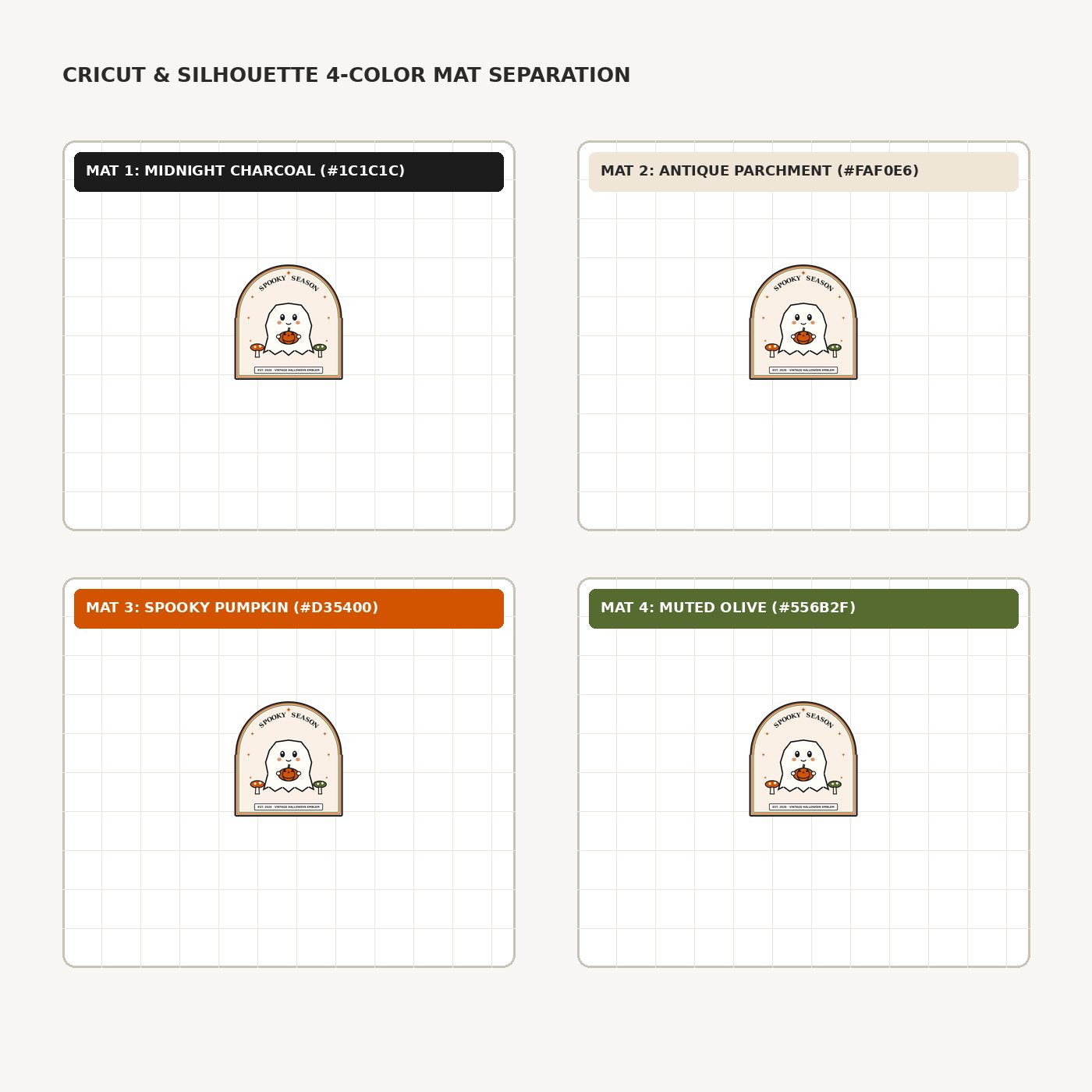
5. Color-Separated Mat Architecture
Multi-color HTV projects frequently suffer from bulky vinyl layering where multiple sheets are stacked on top of each other, making the chest of a t-shirt feel like stiff cardboard.
In our multi-layer cut suites (such as the Vintage Ghost Halloween SVG and Mega Craft SVG Master Bundle), layers are engineered with **butt-joint separations and 0.02-inch trap margins**:
- Each color layer cuts on its own discrete mat with dedicated Cricut registration marks.
- Color boundaries fit together flush against the fabric rather than stacking in thick layers.
- Garments remain soft, breathable, and flexible after heat pressing.
---
*Explore our complete library of production-tested SVG cut files and digital craft assets in the SVG Cut Files Catalog and discover comprehensive multi-project collections in our Craft Bundles.*